← All projects
Jan 2026 – Jun 2026 · Senior Capstone — AIAA, Oregon State University
Active Roll Control System for Solid Rocket
Design and development of an active roll-control system for the OSU AIAA Student Competition Rocket Team (SCRT), using an internally actuated trim-tab mechanism integrated within the existing fin geometry.
Overview
This capstone starts from a blank-sheet problem: the SCRT rocket had no active roll-control hardware in the baseline configuration. Based on the design proposal, the project objective is to reduce average roll rate by at least one order of magnitude relative to baseline flight data while preserving manufacturability, reliability, and compatibility with competition constraints.
Project goals and requirements
- Integrate control hardware inside existing fin geometry, including a 0.125 in fin-thickness constraint.
- Provide sufficient control authority to exceed estimated worst-case aerodynamic rolling moment.
- Support a fail-safe behavior that returns control surfaces to neutral during power or system faults.
- Maintain a design path that is scalable to full-scale SCRT vehicle architecture.
- Ensure practical manufacturability and assembly with team tools and build workflow.
Concept development and downselect
Multiple concepts were evaluated (canards, trim tabs, spinnerons, fin-can rotation, cold-gas, thrust vector control, differential fin control). A weighted decision matrix was then used to compare concepts against team priorities.
- Decision weighting: Control Authority (25%), Mass (20%), Complexity (10%), Applicability (15%), Reliability (15%), Cost (15%).
- High-authority options like thrust vector control and cold-gas were screened out due to complexity, mass, and integration risk.
- Trim tabs ranked highest in the proposal (weighted score: 4.15) and were selected as the go-forward architecture.
Technical work
- Developed an internally mounted, servo-driven trim-tab system with a shaft-and-hub architecture through the fin root.
- Integrated the trim tab, hinge shaft, support structure, and coupling hardware into CAD while preserving flush neutral alignment for low drag.
- Used aerodynamic roll-moment reasoning to size deflection behavior and verify that modest tab angles can generate meaningful corrective authority.
- Mapped actuator needs to hinge-moment loading and servo-selection criteria (torque, response speed, resolution, thermal limits).
- Established a validation path including bench torque/response testing, structural checks in hinge regions, and baseline-vs-controlled flight roll-rate comparison.
Risk and validation strategy
- Primary risks identified: hinge-region structural stress, servo under-torque, trim-tab flutter, and constrained packaging conflicts.
- Mitigation approach: incremental verification from bench tests to subsystem prototype to integrated flight testing.
- Planned checks include stress/deflection review, simulated load torque tests, and control stability evaluation to avoid oscillatory over-correction.
- Final success metric remains direct comparison of roll-rate data against uncontrolled baseline flights.
CAD and drawings gallery
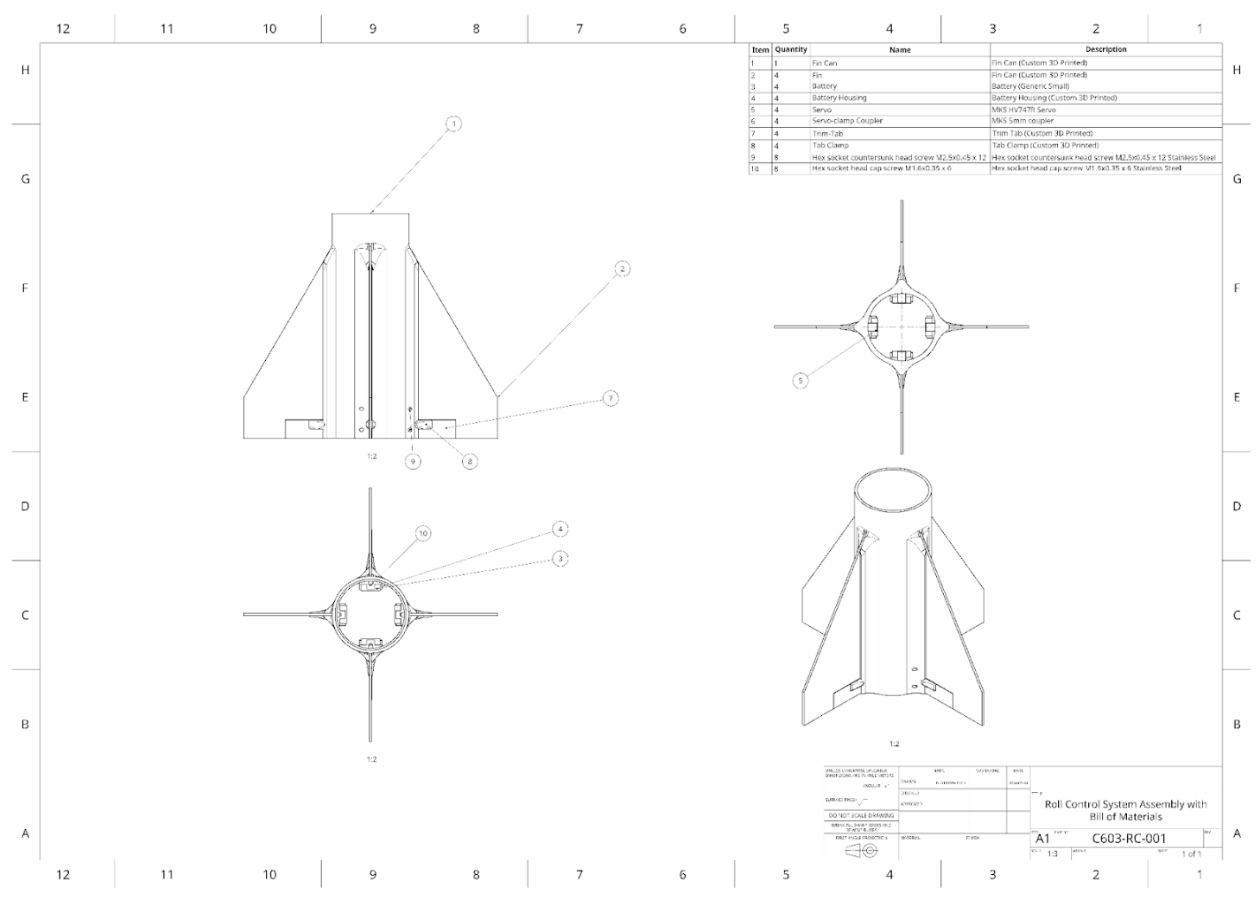
CAD assemblies and engineering drawings for the trim-tab roll control integration.
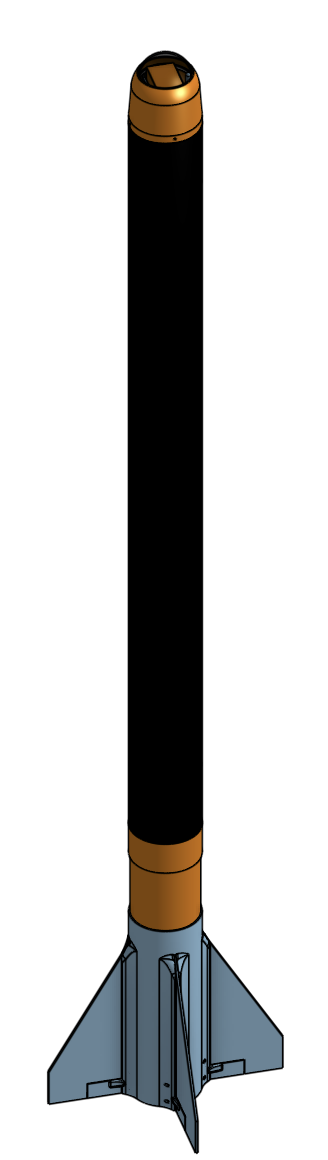
Full assembly
Overall integration view of the fin and roll-control hardware in context.
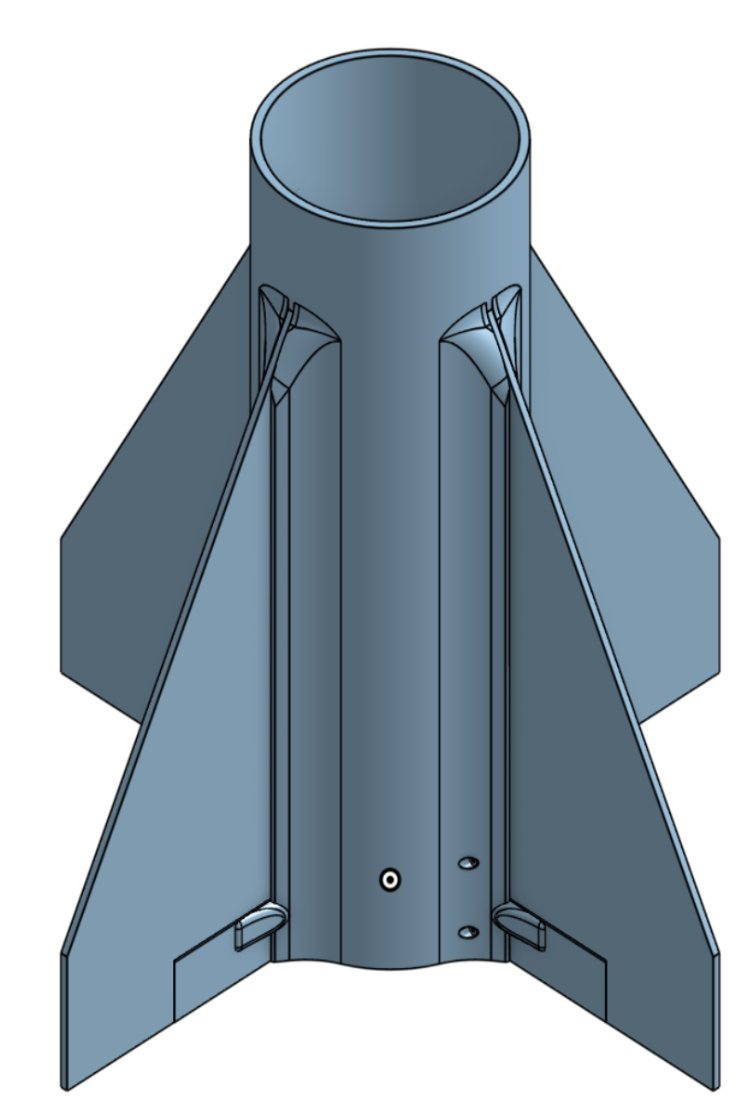
Trim tab assembly
Assembly-focused view of the trim tab and local mounting features.
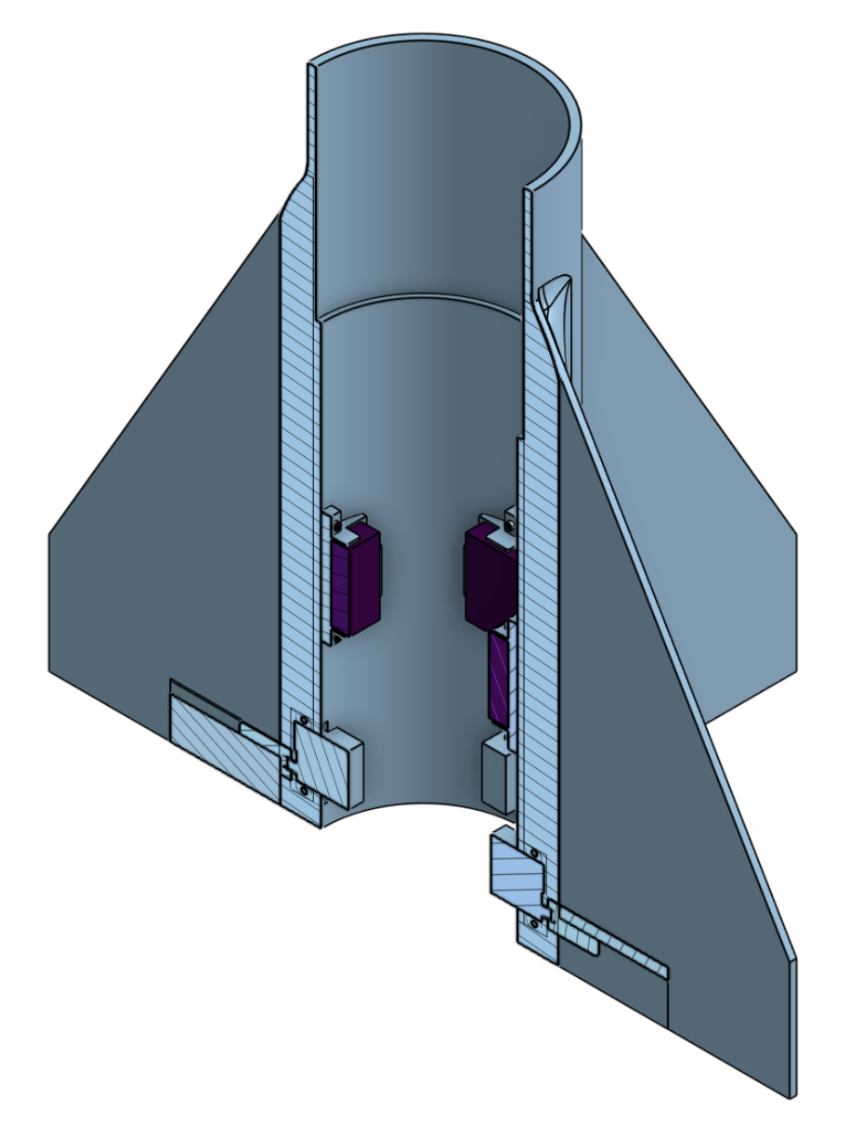
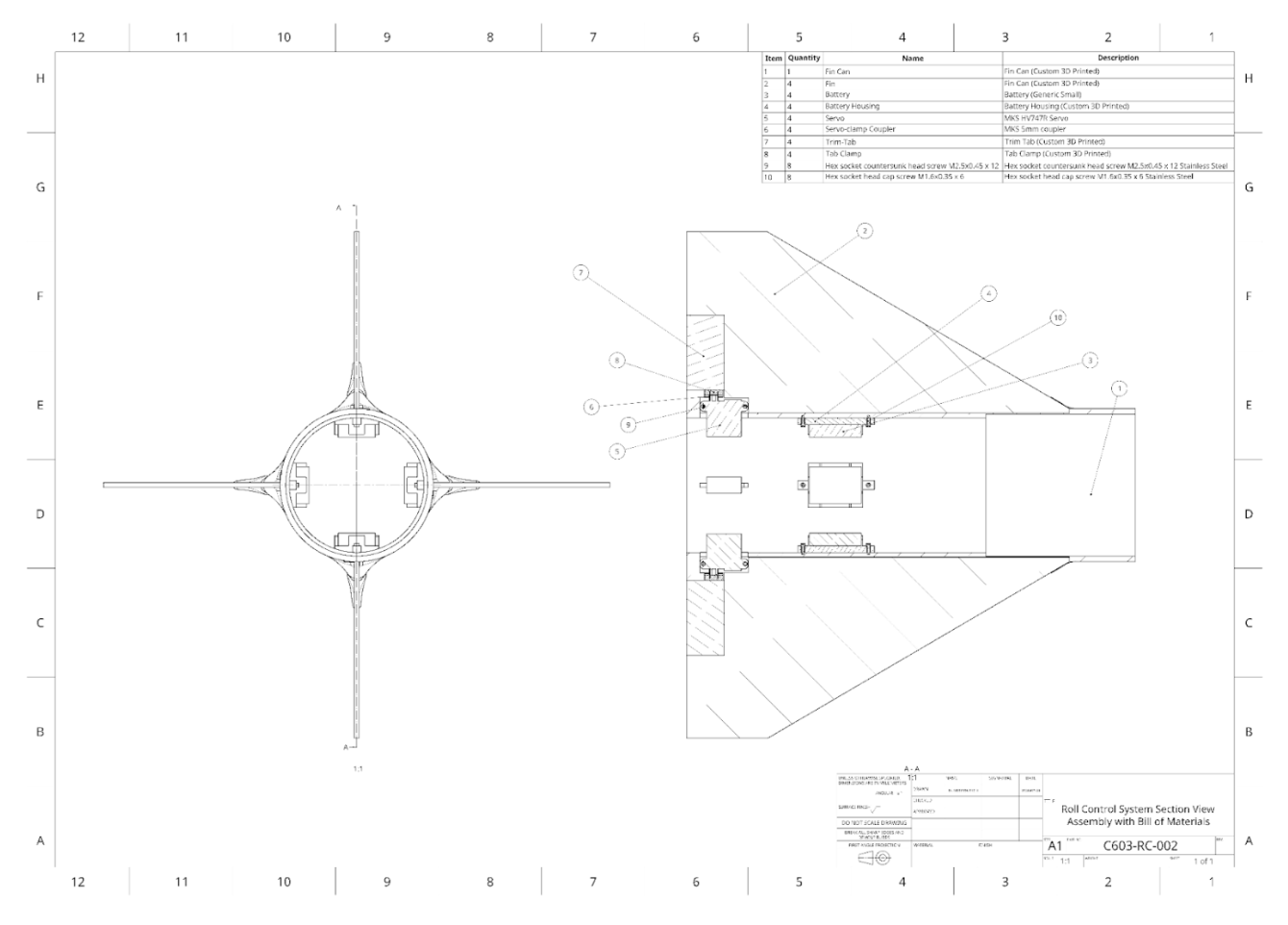
Section cut (assembly)
Section model illustrating internal packaging and interfaces through the fin.
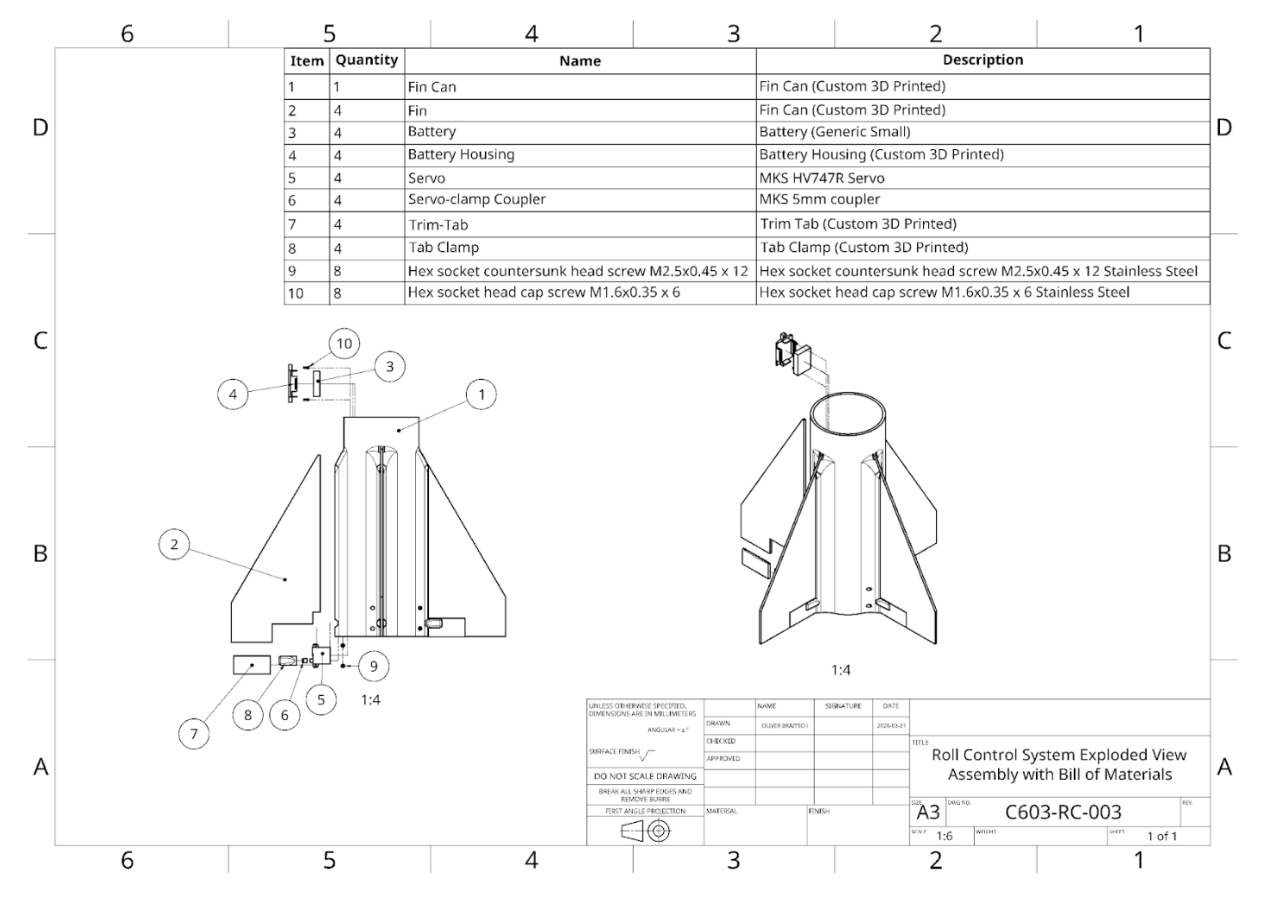
Exploded view drawing
Exploded assembly drawing for part relationships and build order.
Trim detail drawing
Detail drawing for the trim tab geometry and fabrication notes.
Section view drawing
Section drawing supporting tolerance stack and interface verification.
Resources
Current project documents and references.